ClickHouse Ingestion at Scale: An Open-Source Zepto Engineering Story
📊 Level ⭐⭐⭐ | 10.8KB
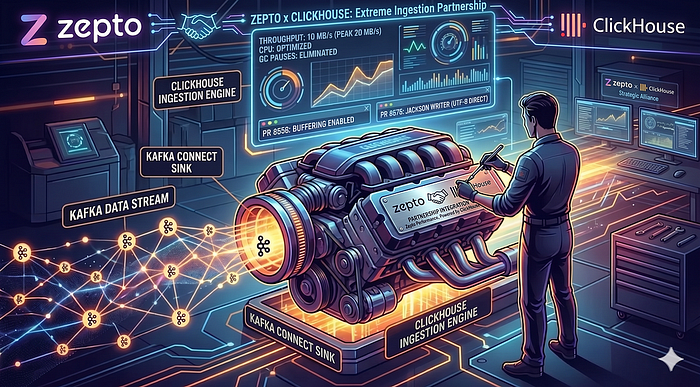
Much like our journey described inDebezium at Scale, our architecture relies heavily on real-time data flow. To understand user journeys, track operational metrics, and power our growth, we built Lucid — Zepto’s completely in-house product analytics engine designed to replace Mixpanel.
Lucid captures millions of events per minute, routes them through Kafka, and dumps them into ClickHouse to give us lightning-fast, high-precision insights without the third-party SaaS pricing trap. We use Confluent Cloud to manage our Kafka infrastructure and thein-house ClickHouse Sink Connector. It was seamless — until our scale broke the default physics.
Every hyper-growth engineering team eventually hits a wall where managed abstractions turn from a blessing into a bottleneck. For us, that wall appeared right at the intersection of Apache Kafka and ClickHouse.
To ingest billions of events into ClickHouse for Lucid at a sustained throughput of 10 MB/s (peaking up to 15–20 MB/s), we hit a wall with Confluent Cloud’s managed infrastructure because its managed nature restricted our access to low-level broker and connector tuning. Instead of migrating our entire Kafka ecosystem, we proved our batching hypothesis on an In-house Kafka Proof-of-Concept, and then built that buffering logic directly into the open-source ClickHouse Kafka Connect framework. By rewriting core parts of the connector, we boosted ingestion by 45%, eliminated crippling GC pauses, and drastically reduced ClickHouse insert pressure.
This is the story of how we overcame the black box of managed cloud, the hidden performance killers we found in the open-source connector, and the two major pull requests we merged to fix them and contribute back to the community.
深度分析
The architecture and the shape of the load
Lucid is Zepto's fully in-house product-analytics engine, built to replace Mixpanel: it captures millions of events per minute, routes them through Kafka, and lands them in ClickHouse for low-latency insight without third-party SaaS pricing. The managed half of the stack is Confluent Cloud; the owned half is an in-house ClickHouse Sink Connector. The load that eventually broke the defaults: billions of events at a sustained 10 MB/s, peaking at 15–20 MB/s.
The wall was a flush policy, not a throughput ceiling
Facing consumer-group lag, the team first suspected broker-side fetch limits — KIP-541 caps fetch.max.bytes at 55 MB by default in open-source Kafka. Confluent Cloud's Kora engine exposes no one-to-one equivalent: it enforces cluster capacity guardrails, partition-level ingress/egress limits, and connector throughput limits instead. That suspect was wrong. A "5 Whys" chain ran the symptom down into the code — the cluster threw Too many parts in order by because a columnar store that thrives on large, infrequent inserts was receiving thousands of tiny inserts per minute; those existed because the sink's flush cadence was hard-wired to the consumer's poll() loop, so ClickHouseSinkTask.java flushed exactly as many rows as a single poll returned (a 500-record poll flushed 500 records). Every consumer override was tried (fetch.min.bytes, fetch.max.wait.ms, max.poll.records, timeouts) and none closed the gap: with broker fetch capped at 20–55 MB and an average record of ~3 KB, the ceiling was ~7,000–18,000 records per poll, ~7,000–9,000 in practice — one poll() cycle cannot mathematically assemble the batch ClickHouse wants, which is why Kafka Connect has no native connector-level batch control. The generalizable reading: the engine was never too slow; the abstraction's default policy simply did not match the workload's shape.
The fix path: prove it cheaply, then change the open core
Three steps, in increasing cost. First, an in-house Kafka PoC: with the low-level polling and fetch knobs finally under their control, the pipeline stabilized instantly — hypothesis proven, and a wholesale migration off Confluent Cloud ruled out in the same breath. Second, PR #658 moved buffering inside the connector and decoupled flushing from the poll() lifecycle with two new knobs: bufferCount (records to accumulate across multiple polls before flushing) and bufferFlushTime (maximum wait in milliseconds). INSERTs hitting ClickHouse dropped by more than an order of magnitude, the too-many-parts errors vanished, and cluster health stabilized. Third, PR #676 removed a silent CPU killer: worker CPU pegged at ~80% with runaway GC, and the flame graph pointed at JSON serialization rather than network I/O or compression. The connector was instantiating per-call Gson objects for every record and doing Struct → UTF-16 Java String → .getBytes(UTF_8), allocating gigabytes of throwaway strings per minute on the hottest path; it was replaced by a shared static Jackson ObjectMapper using writeValueAsBytes() (straight to UTF-8 bytes) plus a custom JsonSerializer<Struct>. Net outcome: ingestion up roughly 45%, GC pauses eliminated, ClickHouse insert pressure drastically reduced.
Open source as the escape hatch from a managed ceiling
Three exits existed: buy a bigger managed tier, migrate the entire Kafka estate, or change the software underneath. The first does not remove the mismatch — the guardrails still hide the knobs that matter; the second is a platform-scale migration the team declined; the third was taken, and was only available because the ClickHouse Kafka Connect framework is open source. They could rewrite batching semantics inside the sink task, replace the hot-path serializer, and kill per-call allocation — none of which a managed connector exposes as configuration. The cost is real (fork maintenance, upstream review latency, divergence risk); the return is a permanent configuration surface instead of a support ticket, merged back so the community inherits it. Both root causes were independently corroborated: discussion #400 showed consumer-level fetch overrides cannot accumulate batches without broker-side tuning, and a commenter on PR #658 reported production v1.3.5 issuing one INSERT per partition per poll (~45 partitions per task), collapsing overnight throughput to ~750 records/s against a ~50K/s recovery need. Read beside Zepto's own Real-Time Personalisation at Scale, this is the ingestion half of the same in-house-infrastructure bet; it also rhymes with Building Jaeger's ClickHouse Backend, where ClickHouse wins come from matching write shape to the storage engine, and with the Storage/Workload Architecture Taxonomy, which frames the split between a platform's guardrails and the workload semantics you actually need to control.
实践启示
- Treat batch size and flush interval as first-class capacity parameters — for a columnar sink, flush policy is a bigger lever than raw broker or database throughput.
- Run the "5 Whys" down to the code line before buying more capacity. "Too many parts" resolved to
poll()coupling inClickHouseSinkTask.java, not to "ClickHouse is too slow"; do the arithmetic (record size × fetch cap) to prove one poll can never satisfy the sink. - Prove the hypothesis on a throwaway PoC first. A small in-house Kafka cluster found the knobs in hours and simultaneously ruled out the expensive migration.
- Profile before optimizing, and suspect serialization on hot paths. A throughput cap that looked like network I/O was GC churn from per-record Gson instances and UTF-16 → UTF-8 conversion; prefer direct-to-bytes serializers and shared static mappers.
- Know where the door is in a managed abstraction. When a managed connector becomes the ceiling, check whether the open-source dependency beneath it can be changed before paying for a higher tier or migrating.
- Quantify the result and push the fix upstream. Measured gains (≈45% ingestion, GC pauses gone, order-of-magnitude fewer inserts) plus merged PRs turn a fragile local patch into permanent product capability, with community threads supplying independent validation.
The Inciting Incident: The Confluent Cloud Black Box
→ 原文存档
关联
- 相关概念: Harness Engineering