Data modeling patterns for Amazon Quick Sight multi-dataset relationships
Ch11.254 Data modeling patterns for Amazon Quick Sight multi-dataset relationships
📊 Level ⭐⭐ | 5.0KB |
entities/data-modeling-patterns-for-amazon-quick-sight-multi-dataset-.md
Data modeling patterns for Amazon Quick Sight multi-dataset relationships
→ 原文存档
Data modeling patterns for Amazon Quick Sight multi-dataset relationships
In Part 1 of this series, we introduced Amazon Quick Sight Multi-Dataset Relationships and covered the foundational concepts of dimensional modeling, best practices for designing clean data models, and a decision framework for when to use runtime joins versus pre-joined datasets. If you haven’t read Part 1 yet, we recommend starting there.
In this post, we shift from concepts to patterns. For each schema, you’ll find a table structure, use cases, implementation steps, and sample SQL queries. We also cover workarounds for advanced scenarios that require extra modeling steps, and close with a summary of current limitations.
Note: All Multi-Dataset relationships in the current release use inner join. Only rows with matching keys in both datasets appear in query results. Design your data model accordingly.
Supported patterns
The following seven scenarios are natively supported by Quick Sight Multi-Dataset Relationships. Each scenario maps to a common data modeling pattern, with concrete implementation guidance and sample SQL.
Scenario 1: Simple star schema
The most common and recommended pattern. A central fact dataset is related to multiple dimension datasets.
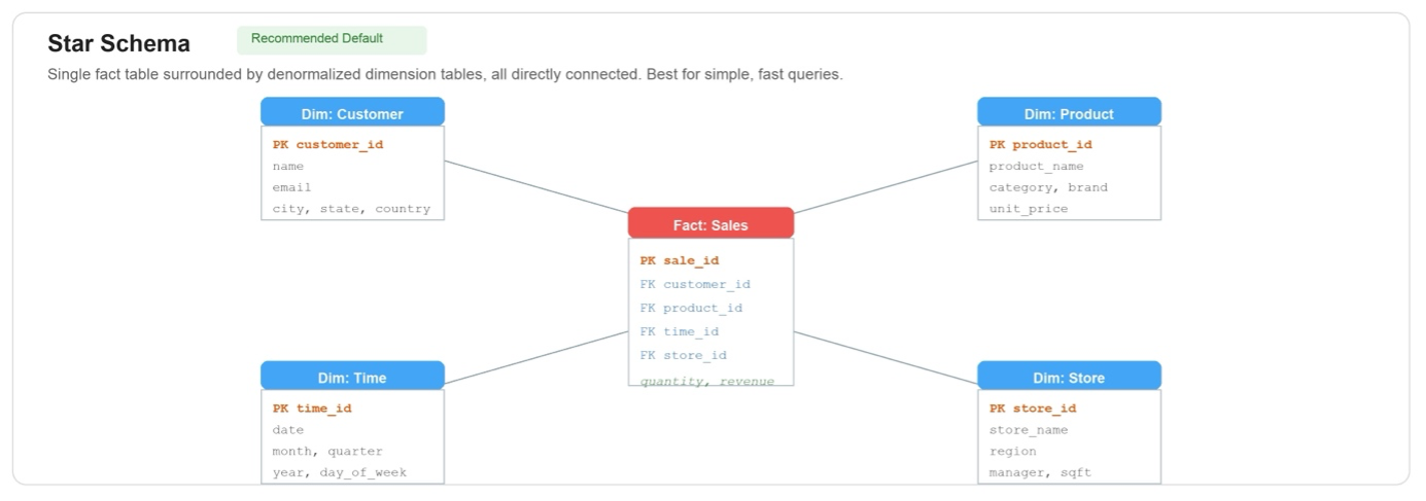
| Table | Type | Cardinality | Key Columns | Attributes/Measures |
|---|---|---|---|---|
| SALES_FACT | Fact | High: Millions to billions of rows | sale_id (PK) customer_id (FK) product_id (FK) time_id (FK) store_id (FK) | quantity revenue cost |
| CUSTOMER_DIM | Dimension | Medium: Thousands to millions of rows | customer_id (PK) | name, email, city, state, country, segment |
| PRODUCT_DIM | Dimension | Low: Hundreds to thousands of rows | product_id (PK) | product_name, category, brand, unit_price |
| TIME_DIM | Dimension | Low | time_id (PK) | date, month, quarter, year, day_of_week |
| STORE_DIM | Dimension | Low to Medium | store_id (PK) | store_name, region, manager, sqft |
Use cases
- Total sales by customer segment and region.
- Monthly revenue trend by product category.
- Top 10 stores by average order value.
Implementation
- Create separate datasets for each fact and dimension table.
-
Define relationships via matching keys:
SALES_FACT.CUSTOMER_ID → CUSTOMER_DIM.CUSTOMER_ID
SALES_FACT.PRODUCT_ID → PRODUCT_DIM.PRODUCT_ID
SALES_FACT.TIME_ID → TIME_DIM.TIME_ID
SALES_FACT.STORE_ID → STORE_DIM.STORE_ID
-
All joins are single-hop (fact to dimension), with no chaining required.
- Denormalized dimensions support fast GROUP BY operations without extra joins.
Sample queries
Total sales by customer segment and region:
SELECT c.segment, c.region,

    SUM
关联
- 相关概念: Harness Engineering